Castle Stuart faces the Firth. Old Petty turns inland.
Old Petty’s May 2026 opening gives a Cabot Highlands break a second perspective: farmland, reed beds and castle views beside Castle Stuart’s shoreline drama.
The interesting question at Cabot Highlands is no longer simply how much golf to fit around Castle Stuart. With Old Petty officially open since May 2026, it is how to divide a short stay between two courses that occupy neighbouring ground but direct attention differently. One makes the Moray Firth its defining presence; the other turns through former farmland before finding the estuary. The case for playing both rests on that contrast, rather than on collecting another 18 holes.[1]
The broad view
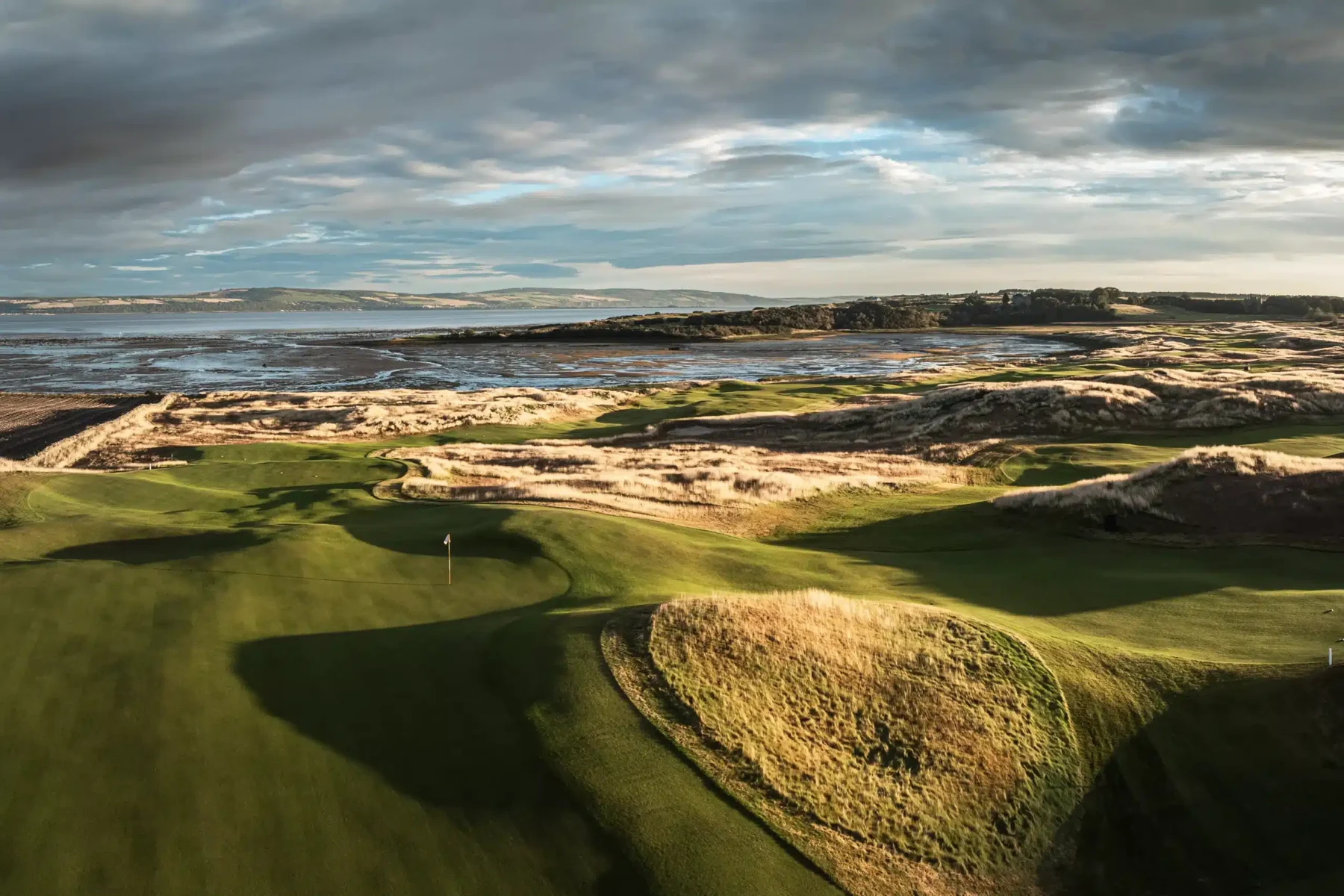
Castle Stuart, opened in 2009 and conceived by Mark Parsinen and Gil Hanse, supplies the expansive half of this visual pairing. Its two-tier routing places holes beside the shoreline and on higher ground, with both nines returning to the clubhouse. Each nine begins with three holes at the water’s edge. The tide changes their foreground: exposed stones and mud at low water, a much closer boundary of sea when it rises.[1]
A comparative photographic essay would give Castle Stuart the wider frames. On the upper tier, the lower holes disappear from view, allowing greens to read against the Firth rather than against another fairway. Yet the architecture offers subjects beyond the panorama: the narrowing approach to the short par-four third, the castle behind the fourth, and the ninth’s two-level fairway climbing towards the clubhouse. These are distinct compositions within the same coastal setting.[1]
A change of direction
Old Petty, designed by Tom Doak with lead associate Clyde Johnson, shifts the emphasis towards the ground and the route through it. Its opening and closing holes occupy the clubhouse side of the road; elsewhere, dry-stone walls, reed beds and agricultural buildings supply reference points. The castle becomes a recurring presence, standing beside the downhill third and appearing on several other lines of play. At the fifth, a red-roofed former farm bothy now serves as a halfway house.[1]
The distinction is not simply sea versus countryside. Old Petty reaches the estuary in its later holes, and the view from the downhill par-three 14th includes Castle Stuart’s third green across the water. That is the revealing comparison: two courses looking into shared space from different positions. Old Petty also changes direction more frequently than Castle Stuart’s predominantly southwest–northeast alignment, changing the relationship between the shots and the wind.[1]
Between rounds
The accommodation keeps this two-course break compact. The renovated, two-storey Farmhouse has four en-suite bedrooms accommodating up to eight, with rooms convertible to twins and a communal great room facing the clubhouse and Firth. Castle Cottage and the Golf Lodge are the other on-site options; the latter sits between Castle Stuart’s 14th and 15th fairways. For a group, the Farmhouse offers a shared base rather than separate hotel rooms.[1]
The architectural counterpoint is the clubhouse itself. Its 1930s-inspired Art Deco and Streamline Moderne styling looks outward through semicircular-fronted windows, taking in a 180-degree sweep of the Firth. After Old Petty’s walls, bothy and inland contours, that broad view restores the larger geographical picture. It also gives the stay a coherent centre: two different rounds returning to the same stretch of water.[1]