Pines, contours and an island-green interruption at Pinheirinho Comporta
Jorge Santana da Silva’s Portuguese course pairs pine-covered terrain with a conspicuous island green, setting up an intriguing architectural contrast before its planned opening.
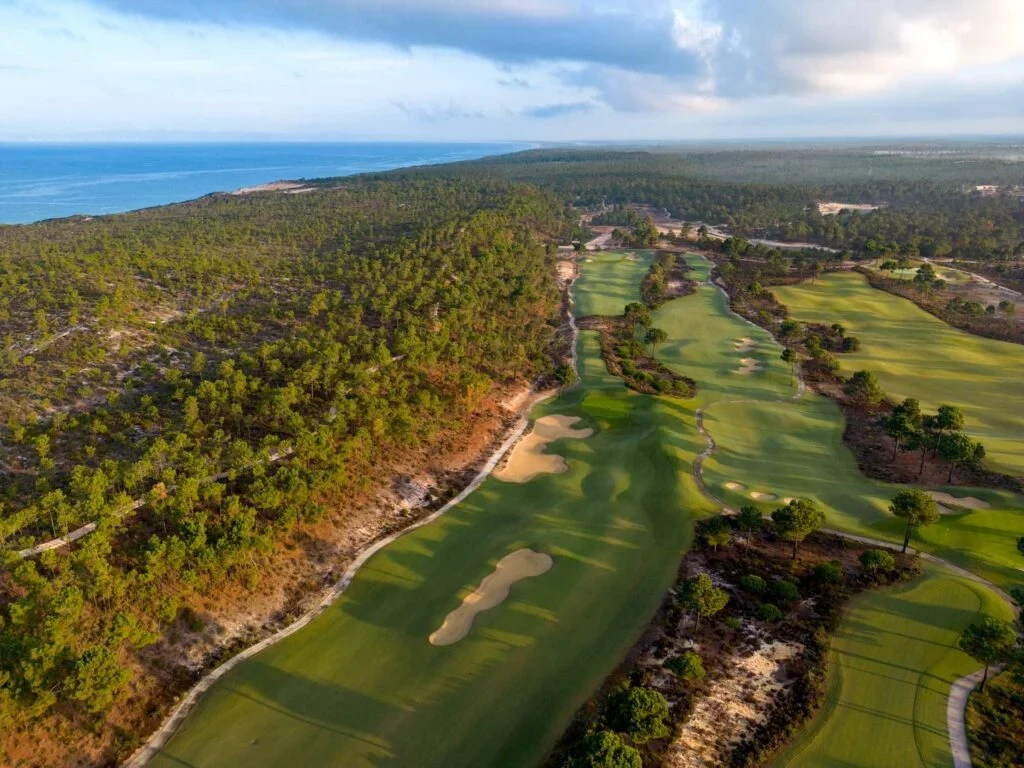
For much of its routing, Pinheirinho Comporta appears to take its cues from what was already there: umbrella pines, rolling ground and natural lakes within a 400-hectare coastal estate. Then comes the 17th. An island-green par three introduces a much more explicit architectural statement, exchanging the broader relationship between golf and its setting for the concentrated drama of a target surrounded by water. That contrast is the most interesting question about Jorge Santana da Silva’s design ahead of its planned March 2027 opening.[1]
Ground before spectacle
The 18-hole course, on Portugal’s Alentejo coast, incorporates the estate’s pine forest, contours and lakes. Elevated tees provide views across the terrain, while expansive, contoured greens and positioned bunkers supply detail at the other end of each hole. These are distinct scales of design: the routing negotiates the larger ground, while the putting surfaces and their defences shape the immediate problem of an approach. The attraction lies in how those scales connect, rather than in the coastal address alone.[1]
Undulation gives that relationship particular interest. A raised tee can make the setting legible, but a contoured green asks the golfer to consider a smaller piece of ground more closely. Size alone says little about how accommodating a putting surface will be; internal movement can make the position of an approach as important as reaching it. Pinheirinho’s combination of elevation changes, broad greens and bunkering therefore offers a more useful architectural starting point than a simple promise of attractive views.[1]
The conspicuous 17th
The island green changes the visual language. Where contours and woodland can spread attention across a hole, water around a putting surface concentrates it on a single destination. Its late position also gives the 17th an obvious role in the round’s closing sequence. The interesting issue is not whether an island green is inherently out of place among pines and lakes, but whether this one feels like a culmination of the course’s water features or a separate showpiece. That is the design tension worth keeping in mind.[1]
The architecture beyond the holes takes a different approach to spectacle. Jacobsen Arquitetura’s clubhouse and restaurant design includes natural materials, floor-to-ceiling glazing and spacious terraces overlooking the course. Those elements put the emphasis on framing the surroundings. Golf also anchors VIC Properties’ wider residential and hospitality scheme, with Six Senses Comporta Hotel and Residences among the proposed additions; the planned resort should not be confused with facilities already available.[1]
Before planning a trip
Pinheirinho has already staged the inaugural Portugal Legends Championship, drawing favourable assessments from Paul McGinley and Michael Campbell, including praise for the terrain, greens and bunkering. That establishes a competitive outing, not a visitor recommendation. Members and guests are expected from March 2027, but visitor eligibility, green fees and tee-time booking arrangements have not yet been specified. For a travelling golfer, those details—not the tournament guest list—will determine whether this intriguing design belongs on an actual itinerary.[1]