The Pond at GC Sylt Has Three Jobs
At GC Sylt, a water hazard doubles as storage and gull habitat, while a fairway renovation makes room for threatened heathland.
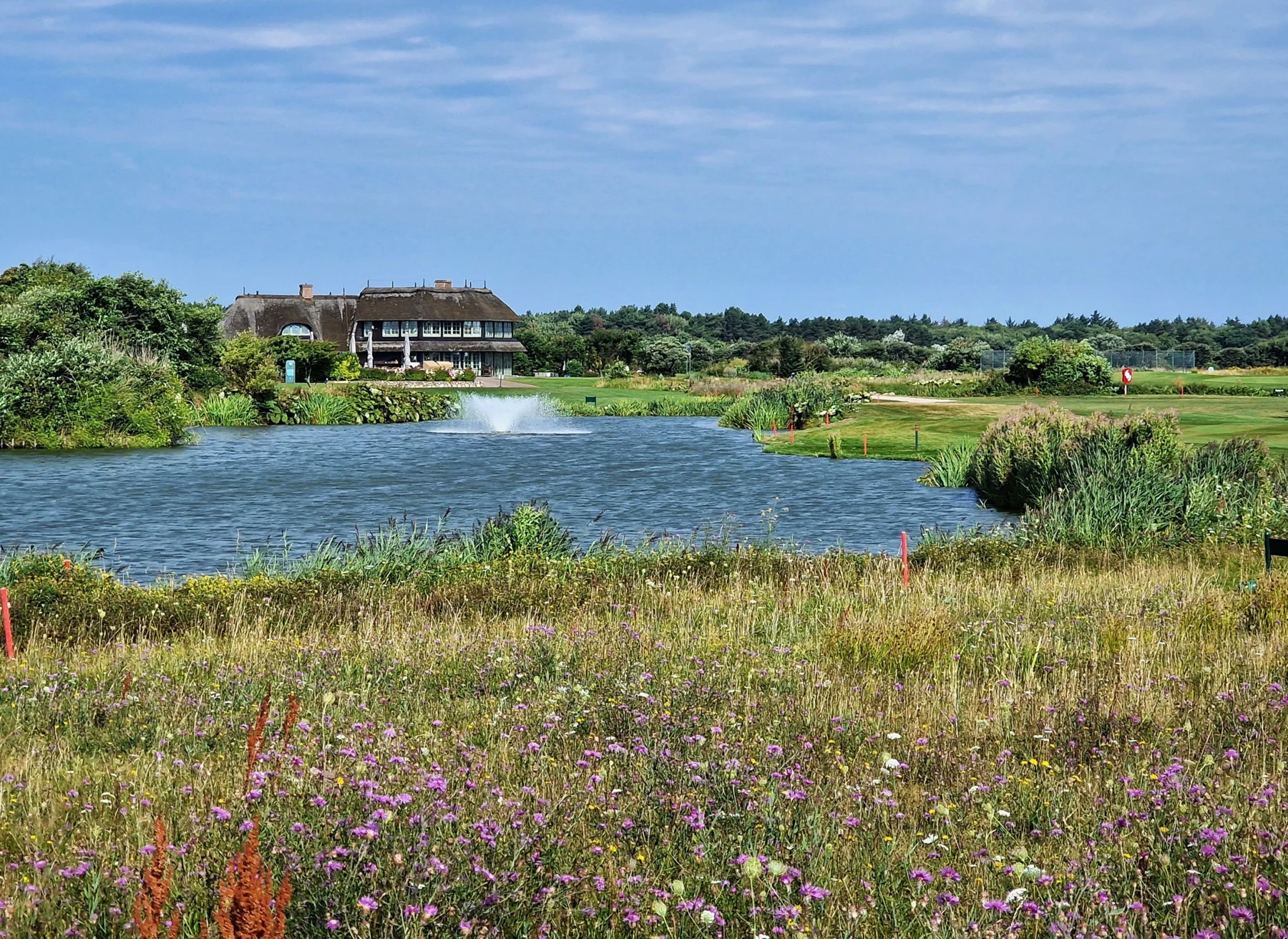
The pond at GC Sylt’s 10th hole has an unusually full brief. It presents a strategic obstacle to golfers, stores water for the club and supports black-headed gulls on its island. In Golf Sustainable’s account of the German island course, published in October 2026, this single feature provides the clearest example of how playing ground and habitat can occupy the same space.[1]
The gulls have occupied the course for years, according to the publication, which identifies the surrounding meadows and wetlands as a source of food. Their island is part of a larger mosaic: the roughly 60-hectare property includes seasonally wet ground, dry grassland and heath. It borders the Braderuper Heide nature reserve, with the Wadden Sea beyond, and has views towards the Kampen dunes.[1]
Room for heath
That setting gives the club’s heathland work particular relevance. Golf Sustainable describes heath as one of Schleswig-Holstein’s most endangered habitats and reports that half the state’s remaining area lies on Sylt. Braderuper Heide is its largest contiguous stretch, a small portion of which extends onto the golf property. Habitat work here therefore concerns vegetation already rooted in the course’s immediate surroundings.[1]
A renovation of eleven fairways included a plan to create more than a hectare of heathland. The renovation is reported as complete; the account does not establish how much new heath has successfully become established. Head greenkeeper Thomas Schweikert’s observations explain why the distinction matters: heath sometimes appears where it was never planted, while elsewhere grasses, herbs or native flowers replace it. A designated area is only the beginning of the work.[1]
Schweikert also works with University of Kiel scientists through the Golf Biodivers programme. Golf Sustainable reports enhancement measures using regional seed on three areas, alongside the club’s longstanding participation in the German golf association’s Golf und Natur environmental certification. Those are specific activities and relationships, rather than proof of an overall environmental outcome. Their interest lies in what is being managed: different habitats within a working golf course.[1]
The second-season test
There is a human timetable alongside the ecological one. Schweikert tells Golf Sustainable that perennial flower mixtures can disappoint players in their first season, but that the biodiversity projects have drawn considerable approval by the second year. He also describes a flowering patch that developed from leftover regional seed. His account suggests that golfers’ acceptance can depend on allowing planting enough time to become recognisable as an intentional part of the course.[1]
For golfers, the useful way to read Sylt is through these individual features rather than a blanket sustainability label. At the 10th, the water has a role in the shot, the club’s water management and the gulls’ habitat. Around the renovated fairways, the question is what establishes over successive seasons. The course’s ecological interest rests in those overlapping uses—and in giving the less immediately tidy ones time.[1]