Varese’s medieval clubhouse began its golf life in 1929
A former Benedictine monastery, with interiors curated by Bica Pirelli, gives Varese a starting point for its proposed network of historic golfing homes.
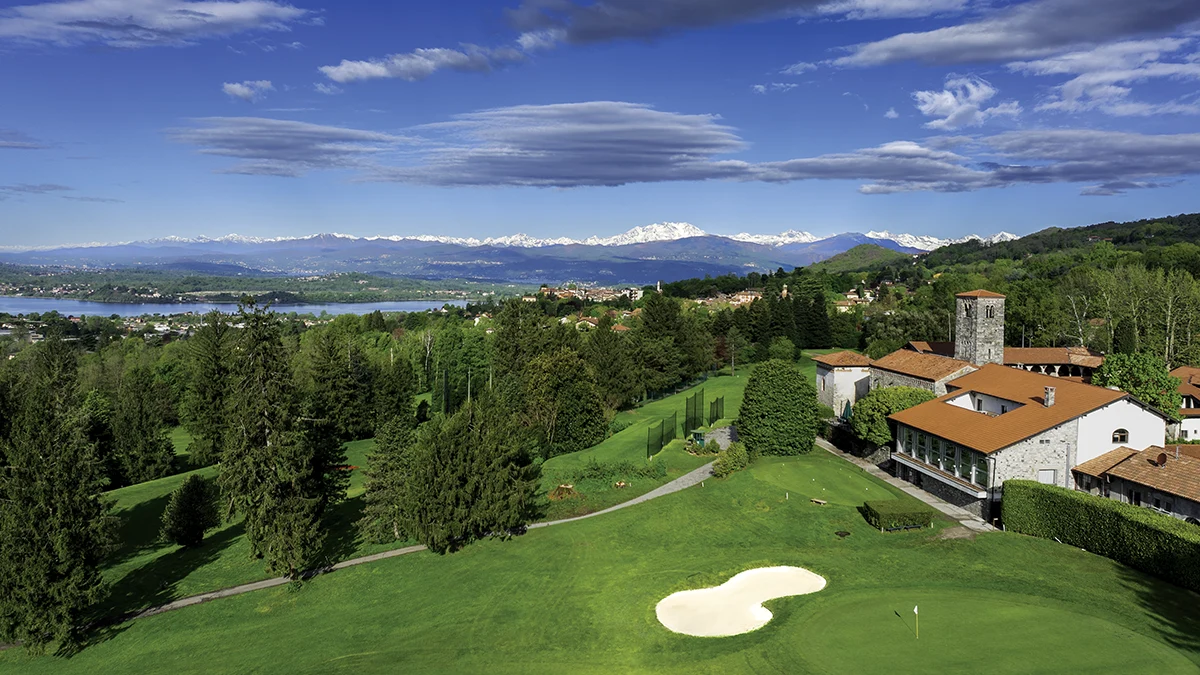
The pivotal date in the architectural story of Golf Club Varese is 1929. That was when the former Benedictine monastery of Sant’Antonino di Luvinate, north of Milan, was restored and converted into a clubhouse, with interiors curated by Bica Pirelli. As Australian Golf Digest’s October 2026 report describes it, the project brought an inherited building into a new sporting setting alongside a nine-hole course by Peter Gannon and Cecil Blanford. Golf was the latest use for the complex, rather than the reason it existed.[1]
The much earlier date attached to Varese is 1129. In remarks published in the report, club president Umberto Gandini identifies that as the date of the earliest document the club has found, suggesting the building itself is older. It is a reference point for the monastery’s history, not the beginning of its service as a clubhouse, and does not establish a world record. The distinction leaves a more interesting architectural question: how does a building with centuries of other purposes become a home for golf?[1]
A building accustomed to change
At Varese, adaptation did not begin with Pirelli’s interiors. The complex temporarily accommodated the nuns of Torba in the 15th century; Archbishop Carlo Borromeo suppressed the religious institution in 1567, and the nuns moved permanently to Varese in 1571. Decline and gradual conversion into a rural farmhouse followed. The property passed through several owners before golf arrived. That farmhouse chapter is especially revealing: the clubhouse’s predecessor was not simply a monastery held intact until a club needed premises, but a place already reshaped by changing needs.[1]
The 1929 restoration therefore belongs within that longer history of reuse. Pirelli’s credited role gives the golf conversion its own interior-design authorship, separate from the building’s medieval origins. The sporting facilities continued to change, too: Donald Harradine expanded the course to 18 holes in the 1950s, and the new layout was unveiled with the October 1958 Italian Open, won by Peter Alliss. Varese’s golf history has its own designers and milestones without needing to stretch back to 1129.[1]
Connecting the houses, not the founding dates
That separation also gives shape to Varese’s proposed Historic Clubhouse network. Gandini describes an international community of clubs occupying castles, palaces and former sacred sites: buildings that acquired golf after earlier lives. According to the report, formal joining rules had not yet been set, although he envisaged rigorous historical criteria and buildings predating the 19th century. The useful organising principle is architectural inheritance, rather than a league table of club founding dates.[1]
Varese already offers a practical counterpart to that proposal. Gandini says it has joined a historic-houses circuit opening to outside visitors twice a year, with tours led by staff trained by FAI, Italy’s national heritage society; members are offered the same experience. Those tours make the building itself a subject of attention, giving its religious, agricultural and golfing chapters room to be understood separately.[1]