Boyne’s Ross Replicas Face a Test That LiDAR Cannot Settle
A replacement par three and a radically rebuilt Dornoch tribute expose the distinction between copying a famous hole’s dimensions and preserving its decisions.
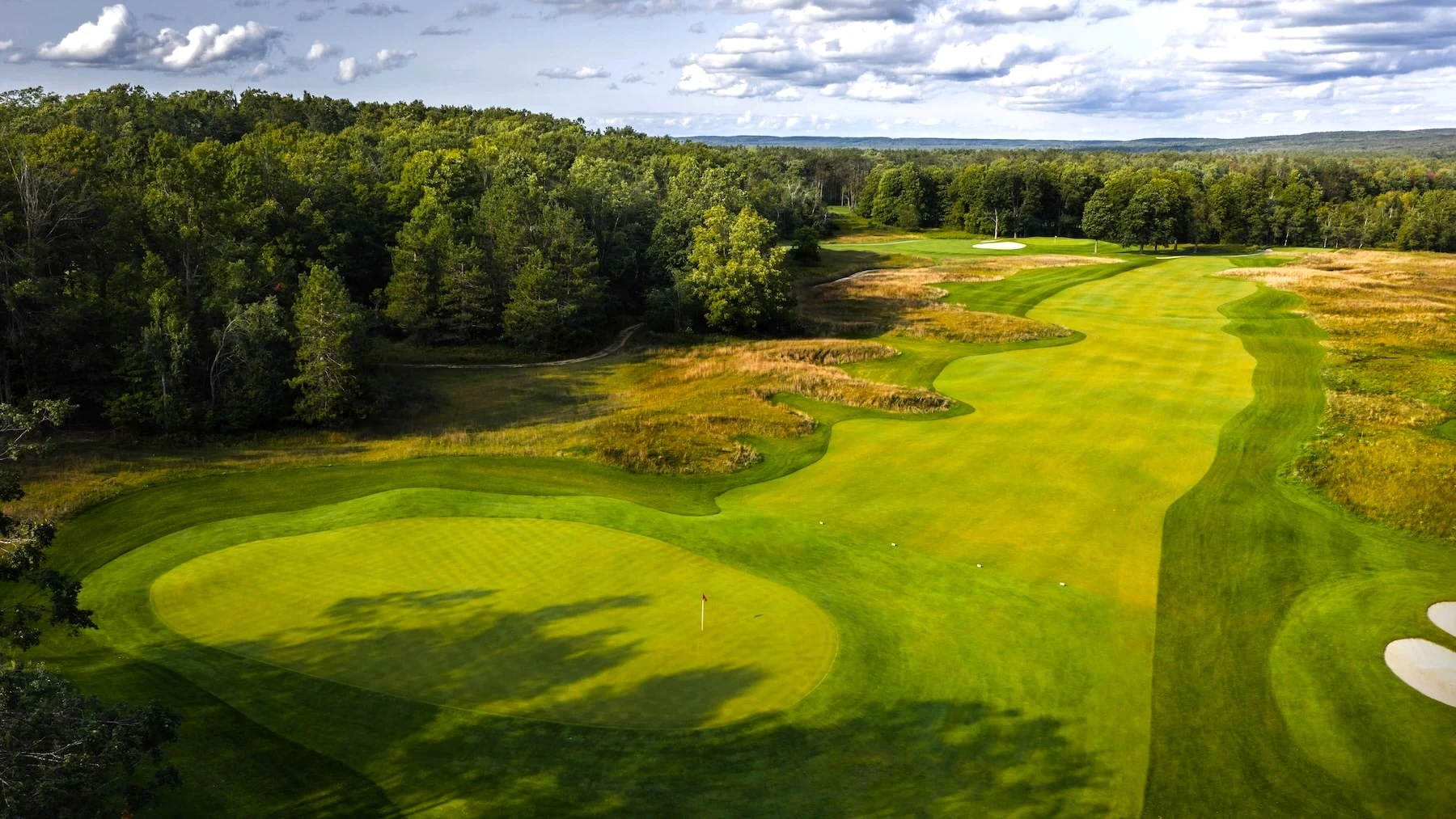
At the Donald Ross Memorial in northern Michigan, making a replica more authentic can mean abandoning the previous model altogether. According to Spike on Golf & Travel’s October 28 report, architect Ray Hearn’s new third hole replaces a rendition of Oakland Hills’ 17th with one inspired by Wannamoisett Country Club’s third. The change poses a useful question for this collection of architectural tributes: is fidelity about reproducing a particular piece of ground, or giving golfers the decisions that made the original worth borrowing?[1]
A small hole’s essential parts
The Wannamoisett-inspired replacement is 139 yards, with a single greenside bunker and a fall-off along the putting surface’s right side. Spike reports that it is due to be fully open for the 2027 season. Those are economical ingredients for an architectural translation: a short shot, a sand hazard and an edge where a missed green can carry a consequence. Hearn describes the Rhode Island original as an example of Ross creating strategic interest within a very short par three. Preserving that relationship between target and trouble matters more than simply matching the yardage.[1]
The rebuilt 10th tackles a different problem. Its reference is Royal Dornoch’s 14th, a formative influence on Ross rather than a hole the account identifies as his design. Ross worked at Dornoch as professional and greenskeeper, developing ideas under Old Tom Morris’s influence. This makes the Michigan hole a tribute to an architectural education as much as a reproduction from a designer’s catalogue.[1]
Rebuilding the view
Here, the reported alterations are substantial: the entire fairway was reshaped, mounding on both sides enlarged and remodelled, and fescue added to evoke Scottish links character. The green became more than three times its previous size and was lowered approximately 4.5 feet. Spike reports improved sightlines into the putting surface. Lowering a green changes what a golfer can see; enlarging it changes the available target. These are consequential adjustments to the way a hole presents its problem, not merely decorative references to Scotland.[1]
Boyne’s case for greater fidelity rests partly on better measurement. The report describes a move beyond the original project’s site visits and photographs to a process using historical imagery, Ross drawings, Google Earth, CAD and LiDAR mapping. No comparative plans or matched photographs are supplied here to verify how closely the rebuilt contours follow their references. The distinction still matters: those tools can document dimensions and landforms, while matching them does not by itself establish an equivalent playing experience.[1]
Nor can a collection transplant each hole’s place in its original round. Boyne’s founding idea was to assemble celebrated holes from different courses; that necessarily gives them new neighbours and a different sequence. Its strongest claim, then, need not be that Michigan becomes Rhode Island or Dornoch. It is that a carefully translated green, bunker or contour can make a particular architectural idea legible somewhere else.[1]