East Potomac’s Championship Plan Comes at the Expense of Its Smaller Courses
The proposed Washington municipal rebuild promises better infrastructure, but removes shorter courses without explaining what affordable golf will cost or preserve.
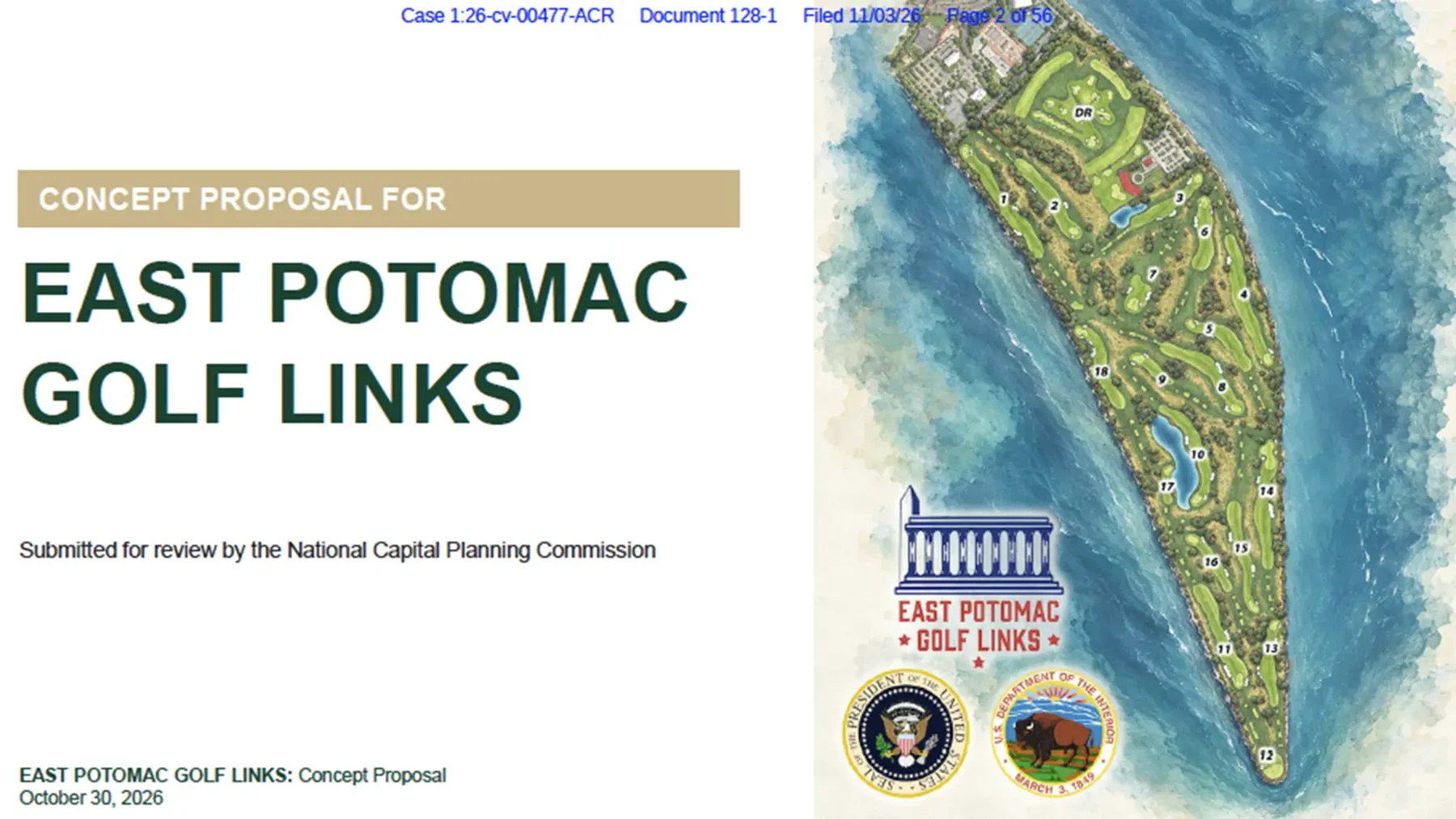
The most consequential architectural decision in East Potomac’s published renovation concept may be what it removes. The Trump administration’s proposal would eliminate the par-3 and executive courses, together accounting for 18 holes, while potentially removing the historic miniature golf course too. Before considering the merits of a championship layout, those losses deserve attention: they would change the kinds of golf available at this Washington, D.C., municipal facility.[1]
The 55-page concept, submitted to the National Capital Planning Commission and made public through litigation involving the Department of the Interior and the DC Preservation League, sets out an ambitious comparison. The administration wants an affordable public championship course in the company of Torrey Pines, Bethpage Black and Houston’s Memorial Park. Those are references for tournament-capable municipal golf. They do not, by themselves, explain how a rebuilt East Potomac would serve its existing players.[1]
Count the golf that goes
East Potomac hosts upward of 80,000 rounds annually, with green fees topping out at $48. That combination of substantial use and modest pricing is a more useful starting point for judging the project than prospective tournament prestige. The existing provision includes different lengths and formats, rather than asking every golfer to fit the same course. Removing the shorter layouts would narrow that choice, even if the principal Blue Course became substantially better.[1]
A par-3 course and an executive course have a distinct architectural purpose: shorter golf is the product, rather than a reduced version of a championship ambition. Miniature golf offers another format again. The concept calls for removing the two shorter courses; the miniature course’s future remains uncertain. Treating all three as peripheral would miss what their presence contributes to the facility’s range of uses.[1]
Repair has a case
There is a serious infrastructure argument for intervention. The proposal documents damage associated with intermittent flooding and begins with a reinforced seawall, estimated at $304.5 million and between two-and-a-half and three-and-a-half years to complete. Protecting the property and improving the main course are legitimate objectives. Neither, however, establishes that eliminating the shorter courses is the right trade-off. Repairing a heavily used municipal facility and recasting its purpose are different decisions.[1]
The same distinction applies beyond the fairways. The concept would extend the rebuilt course to the river’s edge, displacing space used for walking and cycling. It proposes accommodating walking, cycling and fishing opportunities nearby, including at West Potomac Park and the Tidal Basin. Nearby provision is not equivalent to retaining those activities within East Potomac: location is part of what a public park provides.[1]
Then comes the unanswered price question. The administration promises affordability but supplies no expected green fees. Its municipal benchmarks demonstrate that elite tournament golf and resident discounts can coexist; they do not establish East Potomac’s eventual terms. Until those terms are set out, the existing $48 ceiling remains a concrete measure against which an abstract promise must be judged.[1]